



925 Sterling Silver vs. Brass vs. 316L Stainless Steel: A Jewelry Manufacturer‘s Sourcing Guide
When developing a new jewelry collection or expanding an existing product line, brand founders, designers, and sourcing teams face a foundational engineering decision: Should a design be manufactured in 925 Sterling Silver, Lead/Nickel-Controlled Brass, or 316L Stainless Steel?
In custom jewelry manufacturing (OEM/ODM), base metal selection is far more than a raw material price calculation. It directly influences:
- Casting and geometric detail resolution: How sharp micro-prongs, delicate openwork, and organic textures can be rendered in volume production;
- Mechanical durability and everyday wear performance: Resistance to bending, scratching, and structural deformation;
- Surface finishing and plating longevity: Compatibility with traditional micron electroplating vs. modern vacuum ion PVD coating;
- Target commercial positioning: Meeting retail price expectations and consumer perception across demi-fine, contemporary fashion, and everyday lifestyle categories.
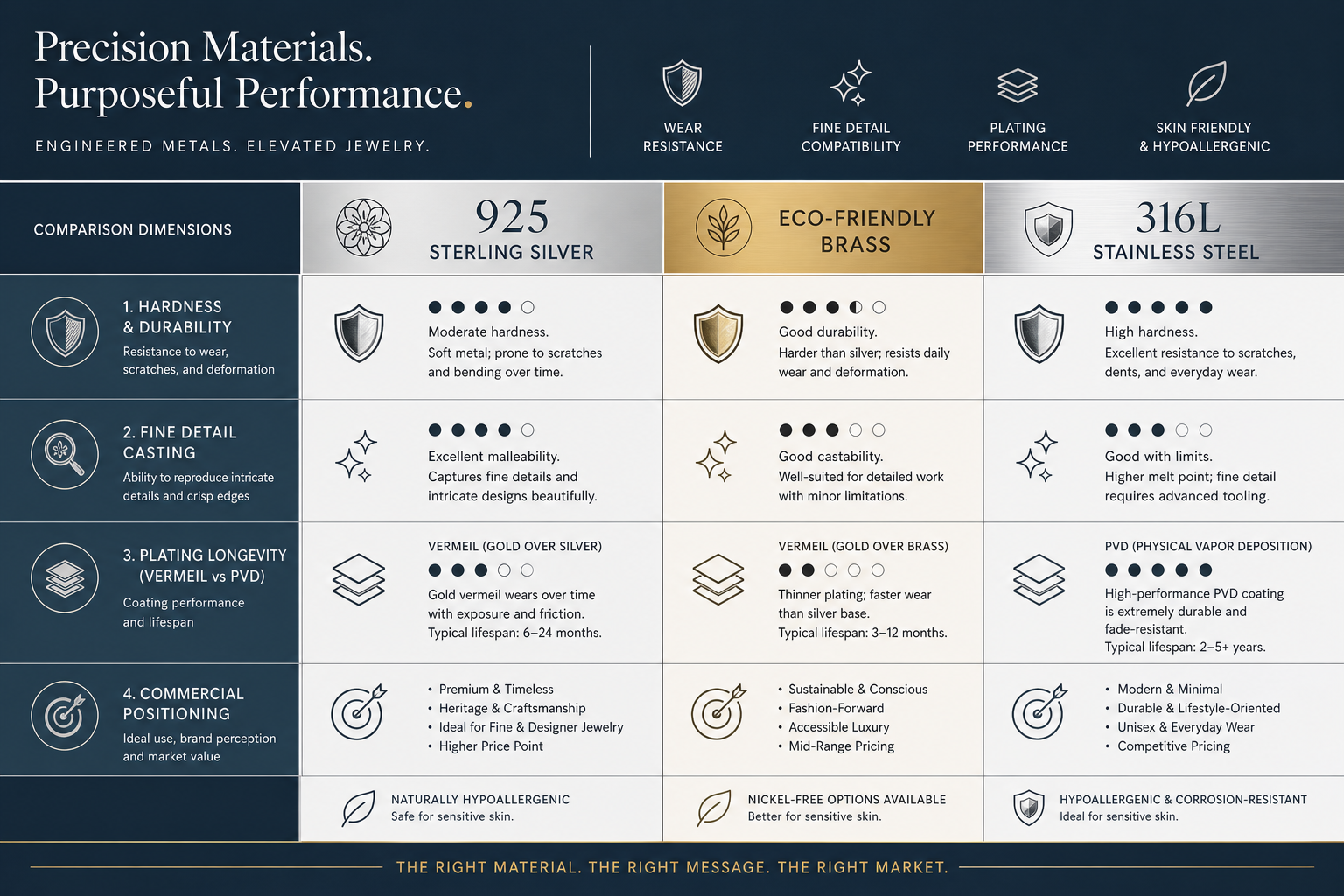
Figure 1: Comprehensive comparison of mechanical properties, finishing paths, and commercial positioning for key jewelry metals.
1. Material Comparison at a Glance
Each material offers distinct structural advantages and manufacturing constraints. The comparison below outlines their technical benchmarks:
| Engineering Metric | 925 Sterling Silver | Lead/Nickel-Controlled Brass | 316L Stainless Steel |
|---|---|---|---|
| Precious Metal Status | Yes (Hallmarked 925 / S925) | No (Base copper alloy) | No (Technical alloy steel) |
| Density & Hand-Feel | ~10.3 g/cm³ (Substantial fine feel) | ~8.4–8.7 g/cm³ (Solid weight feel) | ~7.9–8.0 g/cm³ (Durable, comfortable) |
| Mechanical Ductility & Rigidity | High ductility; excellent for prong setting; requires structural wall design | Moderate ductility; good rigidity for large hollow forms | Very high rigidity; highly resistant to bending and deformation |
| Fine Detail & Micro-Prong Casting | Exceptional; ideal for micro-pavé, filigree & intricate organic sculpts | Excellent fluid flow; sharp architectural reliefs and statement volumes | Moderate in casting; superior in CNC precision turning & geometric planes |
| Primary Surface Finishing | Gold Vermeil (≥2.5µm), Flash Plating, Rhodium, Oxidation | Multi-layer Gold Electroplating + Protective E-Coating | Vacuum Ion PVD Coating (Titanium Nitride / Carbides) |
| Skin-Contact Suitability | Hypoallergenic when alloyed with nickel-free master alloys | Compliant when formulated to lead/nickel limits with barrier layers | Good corrosion resistance; suitability verified via nickel-release tests |
| Typical Brand Positioning | Demi-Fine & Fine Keepsakes ($65 – $350+) | Contemporary Runway & Fashion Statement ($35 – $150) | Everyday Wear, Active & Modern Lifestyle ($30 – $120) |
2. Engineering Properties and Design Constraints
A. 925 Sterling Silver: The Demi-Fine Industry Standard
Composed of 92.5% pure silver and 7.5% copper/alloying elements, 925 Sterling Silver remains the foundation of global demi-fine jewelry. Silver possesses high optical reflectivity, imparting an unmistakable luminous white sheen.
Key Manufacturing Strengths:
- Ductility & Stone Setting: Silver‘s balance of malleability allows bench technicians to burnish micro-prongs, bezel walls, and channel seats over gemstones without cracking (see our guide on Manual Cleanup & Finishing Standards);
- Gold Vermeil Eligibility: In the United States, the FTC Jewelry Guides define vermeil using a sterling silver base, specified gold fineness, and a minimum overall thickness equivalent to 2.5 microns of fine gold (see Gold Vermeil Plating Thickness Guide);
- Precious Metal Recognition: Hallmarking (
925/S925) provides clear value recognition for consumers seeking fine keepsake pieces.
Engineering Consideration: Raw silver naturally reacts with atmospheric sulfur to form silver sulfide tarnish. Finished pieces require protective plating (rhodium, gold, or e-coat) and calibrated wall thickness (see Jewelry CAD Structural Checks) to prevent physical bending during daily wear.
B. Lead/Nickel-Controlled Brass: High-Detail Architectural Volume at Controlled Cost
Jewelry brass (high-copper alloy formulated to meet international consumer safety standards) is widely utilized by premium fashion houses and contemporary runway brands.
Key Manufacturing Strengths:
- Fluidity for Voluminous Castings: In molten lost-wax casting, brass exhibits excellent fluidity, enabling bold, hollowed statement cuffs, chunky sculptural earrings, and intricate architectural textures without the raw material cost exposure of precious metals (see Silver Price Variance Management);
- Solid Hand-Feel: With a density close to 8.5 g/cm³, brass maintains a substantial, luxurious weight in the wearer‘s hand;
- Sharp Relief Definition: Accurately reproduces intricate engraving, coin stampings, and organic reliefs.
Engineering Consideration: Raw brass oxidizes readily in contact with skin perspiration. It requires structured multi-layer electroplating—such as copper leveling, a barrier layer, gold plating, and a baked electrophoretic (e-coat) sealing layer.
C. 316L Stainless Steel: Modern Everyday Durability & Tarnish Resistance
316L is a low-carbon, marine-grade austenitic chromium-nickel-molybdenum alloy. In modern lifestyle and direct-to-consumer (DTC) jewelry, it has become a standard choice for active, everyday wear collections.
Key Manufacturing Strengths:
- High Hardness & Rigidity: Resists bending, ring deformation, and mechanical wear over extended daily use;
- Corrosion Performance: Highly resistant to sweat, water exposure, and cosmetics;
- Skin Safety Compliance: The stable passive oxide surface layer provides good corrosion resistance. Skin-contact suitability should be verified against applicable nickel-release requirements (e.g., EU REACH Annex XVII) and finished product specifications.
Engineering Consideration: 316L‘s high melting point (~1400°C) and rapid cooling contraction make it less suited for ultra-delicate micro-pavé prong setting. It excels in geometric profiles, bezel stone settings, signet rings, paperclip chains, and CNC-machined components.
3. Manufacturing Processes: Casting, CNC Machining & Stamping
Manufacturing route selection depends on design geometry, mechanical tolerances, surface requirements, and production volume rather than being strictly locked to a single metal:
Lost-Wax Investment Casting (Primary for 925 Silver & Brass; Specialized for Steel)
Ideal for flowing three-dimensional sculptures, delicate prong crowns, organic nature motifs, and pavé stone bands. Waxes injected from production rubber molds (see our protocol on Sample to Mass Production Consistency) allow economical tree casting with high surface fidelity.
CNC Precision Turning, Stamping & Laser Fabrication (Primary for 316L; Applicable to Precious Metals)
While 316L can be cast in specialized induction furnaces, it achieves its sharpest precision through multi-axis CNC machining, progressive stamping, and laser cutting. This path delivers crisp chamfers, watertight signet cavities, and reliable mechanical hinge assemblies.
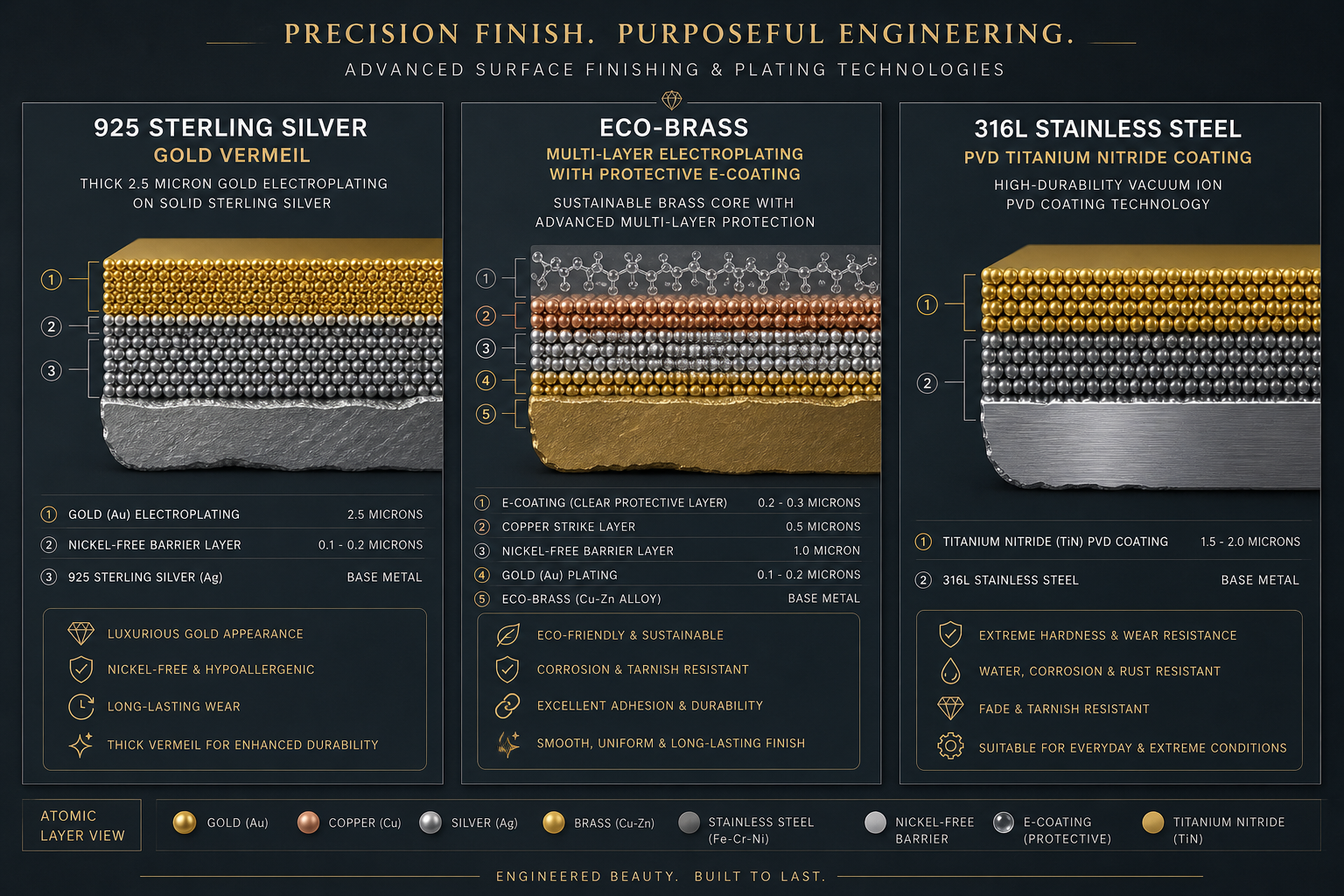
Figure 2: Microscopic cross-section comparison between wet chemical electroplating and high-adhesion vacuum ion PVD coating.
4. Plating and Surface Finishing: Wet Electroplating vs. PVD
The lifespan of a gold finish is governed by the bond between the substrate, pre-treatment, and the coating technology:
1. Wet Chemical Electroplating (For 925 Silver & Brass)
- How it works: Items are submerged in electrolytic chemical baths where dissolved gold ions deposit onto the metal surface via electrical current;
- Visual Quality: Delivers authentic rich gold color tones (14K Champagne, 18K Yellow, 24K Rich Gold, or Rose Gold) and high mirror luster;
- Durability Factors: Longevity is directly tied to deposited thickness (e.g., 2.5µm Gold Vermeil provides extended wear resistance) and the application of protective top-seal e-coatings.
2. Vacuum Ion PVD Coating (Physical Vapor Deposition - Primary for 316L Steel)
- How it works: Inside a high-vacuum chamber, a solid target (such as titanium or zirconium) is vaporized by high-energy plasma and ionized, bonding molecularly with the steel substrate alongside fine gold vapor;
- Visual Quality: Modern PVD achieves refined 18K yellow gold, champagne gold, rose gold, and deep PVD black finishes;
- Durability Factors: PVD coatings provide good wear and corrosion performance when the coating system, substrate preparation, and application parameters are properly controlled. Durability should be validated for intended use conditions.
5. Material Selection by Product Type
| Product Category & Design Type | Recommended Metal | Engineering & Commercial Rationale |
|---|---|---|
| Fine Micro-Pavé, Birthstone & Keepsake Rings | 925 Sterling Silver | Silver provides the necessary ductility for secure micro-prong setting and meets customer expectations for precious heirloom keepsakes. |
| Chunky Sculptural Hoops & Statement Cuffs | Lead/Nickel-Controlled Brass | Allows bold architectural volume and substantial hand-weight while maintaining accessible retail price points without precious metal surcharges. |
| Everyday Chains, Signets & Minimalist Bands | 316L Stainless Steel | Offers robust wear and corrosion resistance with PVD coating, making it suitable for collections targeting repeatable everyday wear. |
| Luxury Tier Demi-Fine Vermeil Collections | 925 Silver + 2.5µm Gold | Complies with US FTC and international definitions for Gold Vermeil, commanding strong retail positioning in department stores and designer boutiques. |
Frequently Asked Questions (FAQ)
Q1: Can the same 3D CAD design be manufactured interchangeably in 925 Silver and 316L Stainless Steel?
While the visual geometry can be aligned, the technical CAD parameters must be adapted. Stainless steel experiences different casting shrinkage, requires larger feeding sprues, and needs wider clearances for stone setting compared to malleable silver. Our engineering team conducts design-for-manufacturing (DFM) adjustments for each specific alloy (see our CAD Pre-Tooling Checklist).
Q2: How does AIU verify heavy metal and skin-safety compliance?
All raw material ingots and plating formulations are strictly controlled to meet international consumer safety standards, including EU REACH (Annex XVII nickel release limits) and California Proposition 65 lead/cadmium thresholds. Certified compliance testing documentation can be coordinated for brand partner records.
Q3: How should brands specify base metal and plating standards in their Tech Pack?
Define the exact alloy grade (e.g., 925 Sterling Silver, Lead/Nickel-Controlled Brass, or 316L Stainless Steel), target coating process (Gold Vermeil, electroplating micron depth, or Vacuum PVD), and key acceptance tolerances in your production pack (see our Jewelry Tech Pack Preparation Guide).
Planning Your Next Jewelry Collection?
Choosing the right metal is only the first step. Your design geometry, target finish, stone-setting requirements, and production volume all influence the most suitable manufacturing route. AIU Jewelry supports B2B brands with custom OEM/ODM development across 925 sterling silver, brass, and 316L stainless steel.
Share your design files, reference samples, target specifications, and estimated order quantity with our engineering team to review manufacturing requirements before sampling.
 anya907888
