



REACH Annex XVII for Jewelry: What Entries 23, 27 and 63 Actually Restrict
REACH Annex XVII for Jewelry: What Entries 23, 27 and 63 Actually Restrict
.jpg)
Almost every compliance conversation about selling jewelry into Europe eventually lands on the same three words: "REACH Annex XVII". Buyers ask for it, suppliers claim it, and importers get held at customs over it. What most brand owners never get is a plain explanation of which specific entries apply to jewelry, what each one limits, and what the actual numbers are. This article covers those three entries — cadmium, nickel and lead — with the thresholds you can check a supplier‘s documentation against.
What REACH Annex XVII Is
REACH is the EU‘s overarching chemicals regulation (EC No 1907/2006). Most of it governs registration and authorisation for chemical manufacturers, which has nothing to do with a jewelry brand. Annex XVII is the part that does. It is the restriction list — a schedule of substances that may not be placed on the EU market above defined concentrations in defined product types.
Annex XVII currently contains around 80 entries covering everything from asbestos to phthalates in toys. Three of them apply directly to jewelry: Entry 23 (cadmium), Entry 27 (nickel), and Entry 63 (lead).
When a supplier states their goods are "REACH compliant", the two follow-up questions that matter are: which Annex XVII entries were tested, and which individual components were covered. A supplier who cannot answer both has not tested to a defensible scope.
The Three Entries at a Glance
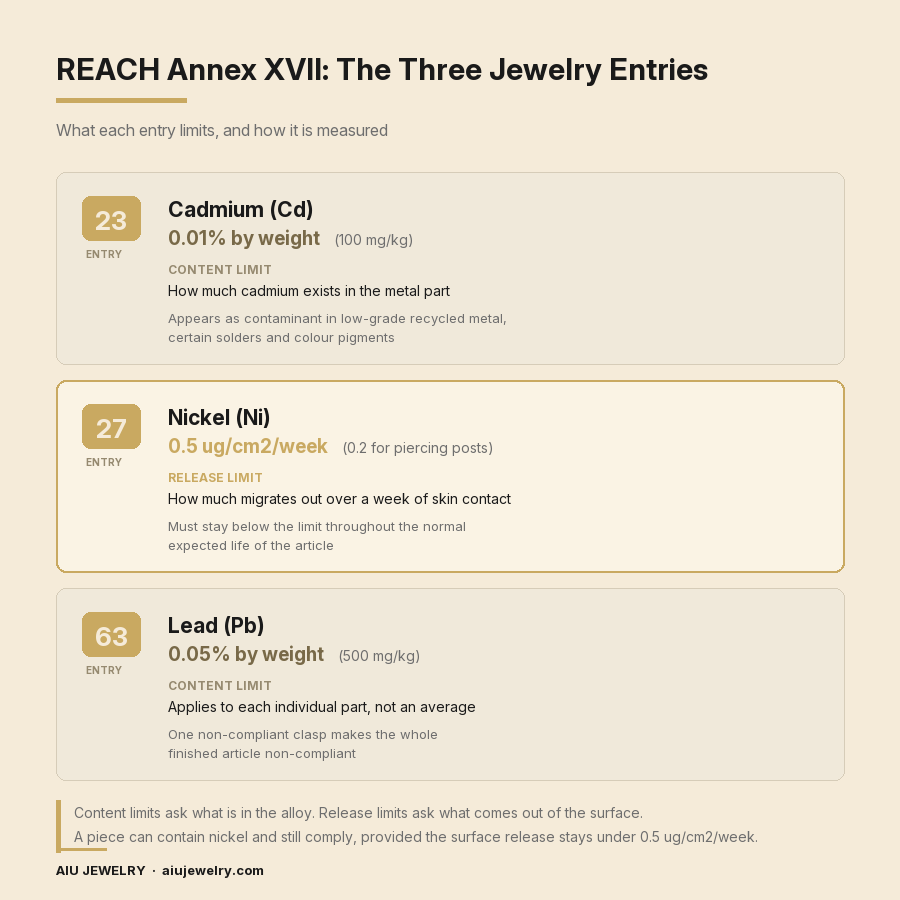
| Entry | Substance | Limit | Measured as |
|---|---|---|---|
| 23 | Cadmium (Cd) | 0.01% by weight (100 mg/kg) | Content in the metal part |
| 27 | Nickel (Ni) | 0.5 μg/cm²/week (0.2 for piercing posts) | Migration / release rate |
| 63 | Lead (Pb) | 0.05% by weight (500 mg/kg) | Content in the individual part |
The distinction in the right-hand column is the one buyers most often miss:
- Cadmium and lead are content limits — how much of the substance exists inside the alloy material.
- Nickel is a release limit — how much migrates out from the surface over one week of simulated skin contact.
A jewelry article may contain nickel within the alloy and still pass compliance, provided surface release stays below the regulatory threshold.
Entry 23 — Cadmium
Cadmium may not be used in jewelry articles at or above 0.01% by weight of the metal. The restriction applies to metal parts of jewelry and imitation jewelry, including hair accessories, bracelets, necklaces, rings, earrings, brooches and watch straps.
Cadmium is not usually added deliberately. It appears as a contaminant in low-grade recycled metal, in certain solders, and in colour pigments used on some plated or enamelled finishes. Even well-intentioned factories carry cadmium risk if alloy raw material sources cannot be fully traced.
Entry 27 — Nickel
Entry 27 restricts nickel in articles intended for direct and prolonged skin contact. The limits are expressed as weekly release rates:
- 0.5 μg/cm² per week for general skin-contact articles
- 0.2 μg/cm² per week for post assemblies inserted into pierced ears or other pierced body parts
Two structural points matter commercially:
- Compliance targets surface release, not bulk alloy content. Testing must measure migration under a harmonised protocol rather than analysing the alloy composition.
- For plated articles, release must stay under the limit throughout the normal expected service life. Valid testing therefore includes abrasion pre-treatment that simulates wear-through of the surface layer.
If you already hold a nickel-release report and want to evaluate it line by line, we cover that in a separate walkthrough on reading a 925 silver nickel-release test report.
Entry 63 — Lead
Lead and its compounds are restricted to 0.05% by weight (500 mg/kg) in every individual component of a jewelry article.
The limit applies per part, not as an average across the finished piece. A compliant chain combined with one non-compliant clasp produces a fully non-compliant finished article.
Certain materials sit outside the restriction — crystal glass, non-synthetic and reconstructed precious and semi-precious stones, and internal watch components not accessible to the user. Enamels and vitreous coatings have their own treatment. If your construction includes any of these, confirm with your supplier which exemption they are relying on and whether their report reflects it.
Where UK REACH Diverges from EU REACH
Since Brexit, two parallel regimes exist. UK REACH governs Great Britain (England, Scotland, Wales). EU REACH continues to apply in Northern Ireland under the Windsor Framework, and of course across the EU27.
For jewelry specifically, the restriction thresholds in UK REACH currently mirror EU REACH as they stood at the point of Brexit. The practical implication is not that you need different testing — it is that your documentation may need to reference the correct regime for the correct destination, and that future divergence is possible. Brands shipping to both GB and the EU should keep this on their watchlist rather than assume permanent alignment.
What This Means for Supplier Documentation
A REACH report that carries weight answers four questions. Which entries were tested. Which components were tested. What the measured values were, not just a pass statement. And when the testing was performed relative to the production batch you are buying.
Our 925 sterling silver line is tested against REACH Annex XVII entries 23, 27 and 63 under a continuing programme rather than per-project. The current representative report, TSNH00597757-1 (issued June 2026), covers 36 distinct part types including chains, jump rings, studs, clasps, stone-set castings and ball beads. For buyers whose risk model calls for a second independent laboratory, we maintain a parallel Bureau Veritas certificate, report (8526)012-0684 (January 2026), covering the same three entries. Our 316L stainless steel line is documented separately under SGS report SZHH01783169.
Testing continuity across part types — rather than a single certificate for one finished item — is part of what supports our 0.03% final-inspection defect rate (based on internal QC records over the past 12 months; an internal quality metric, not a legally binding guarantee). Report formats we work with are shown on our certification and honor page.
On report validity: lab reports apply only to the samples submitted, and are representative of ongoing production batches rather than permanently valid certificates. Switching alloy sources, plating stacks or component suppliers requires fresh testing. Always request the latest valid copies for your specific order before shipment.
Frequently Asked Questions
Is "REACH compliant" on its own a meaningful claim?
Not without specifics. REACH contains restriction entries, an SVHC candidate list, and authorisation requirements — a supplier can mean any of these. Ask which Annex XVII entries were tested and on which components. A supplier who cannot answer that has not tested to a defensible scope.
What is the difference between Annex XVII restrictions and the SVHC candidate list?
Annex XVII entries are hard restrictions with numerical limits — exceed them and the article cannot be placed on the market. The SVHC candidate list triggers communication and notification duties above 0.1% by weight, but does not by itself prohibit sale. They are different obligations and a report addressing one does not address the other.
Do I need separate reports for each material in my range?
Generally yes. Alloy composition drives the result, so a 925 silver report does not evidence compliance for a 316L stainless steel or brass line. Ask your supplier which material families their reports cover. For the broader set of questions worth asking before committing to a factory, see our 7-step supplier vetting checklist.
Does REACH Annex XVII apply to plated jewelry?
Yes, and nickel release under Entry 27 is the primary risk. Plating does not exempt an article — it changes how the article must be tested. Because the restriction requires compliance throughout the normal expected service life, valid testing for plated pieces includes abrasion pre-treatment that simulates wear-through of the surface layer. A nickel-release result measured on virgin plating, without that pre-treatment, can miss failures that only emerge after normal wear. Cadmium and lead limits apply to the base metal and any plating chemistry independently of this.
How often do REACH reports need to be renewed?
There is no fixed regulatory expiry. In practice, renew when the report is over 12 months old, when alloy or plating chemistry has changed, when a new component supplier enters the build, or when your importer‘s compliance team requires documentation dated within a defined window. Non-compliant cadmium, lead and nickel-release results remain among the most common triggers for EU market surveillance action in the jewelry category, which is why importers increasingly ask for current rather than archival reports.
Need this mapped to your own range? Send your target market and material list and we will identify which entries apply and which of our existing reports already cover your components — see the details below.
REACH is the EU baseline — but the EU also requires an established responsible person under GPSR, and the US and UK run entirely different systems. See which test report each market actually demands for the complete picture.
.png)
Not sure which entries apply to your product range? Send us your target market (EU / GB / Northern Ireland) and your material list — we‘ll map which Annex XVII entries your components fall under and which of our existing reports already cover them. Response within 24 hours, under NDA. No commitment required.
 anya907888