



What Is AnchorCert Pro 2? The Jewelry-Specific Allergen Testing Programme Explained
What Is AnchorCert Pro 2? The Jewelry-Specific Allergen Testing Programme Explained
.jpg)
If a supplier hands you a test report headed "AnchorCert Pro", most buyers file it next to their other compliance paperwork without asking what makes it different from a standard nickel test. It is different — and the difference matters if you sell jewelry into markets where skin-contact allergy claims are a live commercial risk. This article explains what the programme covers, who runs it, and where it sits relative to REACH and other routine chemical testing.
Who Actually Runs AnchorCert Pro
AnchorCert Pro is a testing methodology developed by the Birmingham Assay Office in the UK — one of the four remaining British assay offices, operating since 1773. It is not a manufacturer‘s self-certification scheme and it is not an in-house method invented by any single laboratory.
This distinction is worth understanding when you evaluate supplier documentation. A report carrying the AnchorCert Pro method name means the testing followed a UKAS-accredited protocol developed by an independent assay office, and was run by a laboratory authorised to perform it. Intertek is among the laboratories that run this programme for manufacturers in Asia, which is how it appears on reports coming out of the Chinese supply chain.
What Makes It Different: 16 Metals, Not One
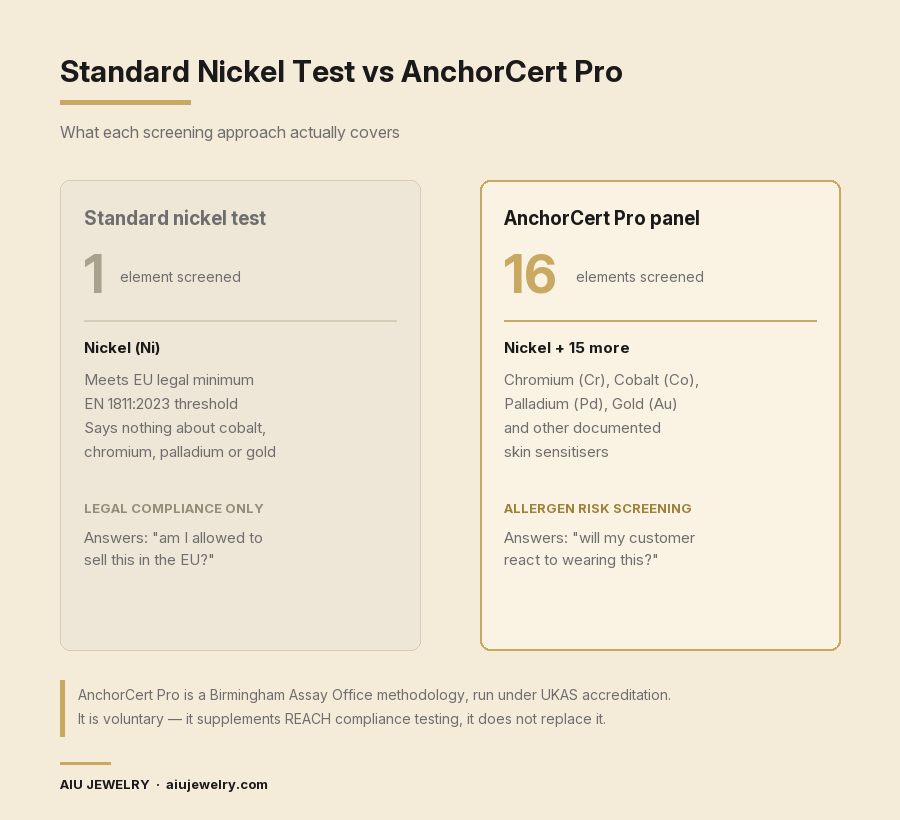
Standard regulatory testing for jewelry focuses almost entirely on nickel, because nickel is the metal named in EU restriction law. That covers the legal minimum. It does not cover the commercial reality that a meaningful share of contact dermatitis cases involve metals other than nickel.
AnchorCert Pro screens for 16 metallic elements associated with allergic contact dermatitis. Alongside nickel, the panel includes chromium, cobalt, palladium, gold and other metals documented in dermatological literature as skin sensitisers. Cobalt and chromium in particular appear in patch-test data at rates high enough that a nickel-only test leaves a real gap.
For a brand, the practical implication is straightforward: a nickel-only report tells you whether you are legally compliant in the EU. A 16-element allergen screen tells you considerably more about whether your customers are likely to react to the piece.
Where It Fits Alongside REACH
These are not competing tests, and one does not replace the other.
| Aspect | REACH Annex XVII testing | AnchorCert Pro |
|---|---|---|
| Purpose | Demonstrate legal compliance with EU restriction entries | Screen for allergen risk across a wider metal panel |
| Metals covered | Nickel, lead, cadmium (Entries 27, 63, 23) | 16 elements associated with contact dermatitis |
| Legal status | Mandatory for EU market access | Voluntary — a commercial risk-management measure |
| Typical driver | Customs, importer compliance requirements | Retail partners, brands with sensitive-skin positioning |
In practice most serious manufacturers run both. REACH testing satisfies the regulator. The wider allergen panel satisfies the retail buyer who has dealt with return rates driven by skin reactions and does not want to repeat the experience.
How AIU Uses This Programme
Our 925 sterling silver line is tested under the AnchorCert Pro 2 programme on a continuing basis rather than per-project. The current representative report, TSNH00597757-1 (issued June 2026), covers 36 distinct part types — pins, hoops, castings, jump rings, chains, studs, stone-set castings, buckles, tail chains, logos, ring chains, caps and ball beads — with EN 1811:2023 nickel release and REACH Annex XVII entries 27, 63 and 23 assessed alongside the allergen panel.
Part-type breadth is the number worth paying attention to in any allergen report. A programme covering a single finished ring tells a buyer very little about the clasp, the ear post, or the jump ring — and those are the components in prolonged skin contact. We maintain a rolling set of reports rather than a single certificate for this reason, and testing continuity is one of the inputs behind our 0.03% final-inspection defect rate (based on internal QC records over the past 12 months).
You can review the report formats we work with on our certification and honor page.
What This Programme Does Not Do
Three limits are worth stating plainly, because overstating allergen testing is a compliance risk in itself:
- It does not license the word "hypoallergenic" as an unqualified claim. Test results describe measured element levels in submitted samples. Marketing language that promises no allergic reaction goes beyond what any laboratory report supports.
- It does not cover materials outside the tested sample. A report scoped to 925 silver components says nothing about a stainless steel clasp sourced separately, or a plated brass finding added later in the build.
- It does not replace market-specific chemical compliance. An allergen panel is not a REACH dossier, a Prop 65 assessment, or a RoHS declaration. Those remain separate requirements tied to separate markets.
Reports apply only to the samples submitted. Product-specific testing remains the appropriate route when a new construction, alloy source or plating stack enters production.
Frequently Asked Questions
Is AnchorCert Pro legally required to sell jewelry in the EU or UK?
No. EU and UK market access is governed by REACH restriction entries, which specify nickel release limits and lead and cadmium content limits. AnchorCert Pro is a voluntary programme that goes beyond those requirements by screening a wider allergen panel. Some retail partners request it contractually even though no regulator does.
How is this different from a standard nickel release test?
A standard nickel release test measures one element against one regulatory threshold. The AnchorCert Pro panel measures 16 elements associated with contact dermatitis, of which nickel is one. If you already hold a nickel-release report and want to understand how to evaluate it in detail, see our walkthrough on interpreting EN 1811 nickel release test reports for 925 sterling silver.
Should I ask a new supplier for this specific programme?
Ask what allergen testing they hold and what part types it covers, rather than naming a programme. A supplier who can only produce a nickel-only report for one finished item is telling you something about the depth of their testing regime. For the wider set of questions worth asking before you commit to a factory, see our 7-step supplier vetting checklist.
This programme is voluntary. If you are working out which evidence is actually mandatory for your markets, start with our guide to which jewelry test report you actually need — it separates the legal floor from the optional extras, market by market.
.png)
Want to know whether your specific components fall within our current tested scope? Send us your part-type list — chains, posts, clasps, settings, findings — and we‘ll confirm which are covered by our existing reports and which would need project-specific testing. Response within 24 hours, under NDA. No commitment required.
 anya907888