



925 Silver Jewelry Plating Compliance Guide: REACH Annex XVII, RoHS, EN 1811 Nickel Release & Hypoallergenic Standards
925 Silver Jewelry Plating Compliance Guide: REACH Annex XVII, RoHS, EN 1811 Nickel Release & Hypoallergenic Standards
Related Reading: 925 Silver Plating Options | Different Plating Processes | Why Plating Fades
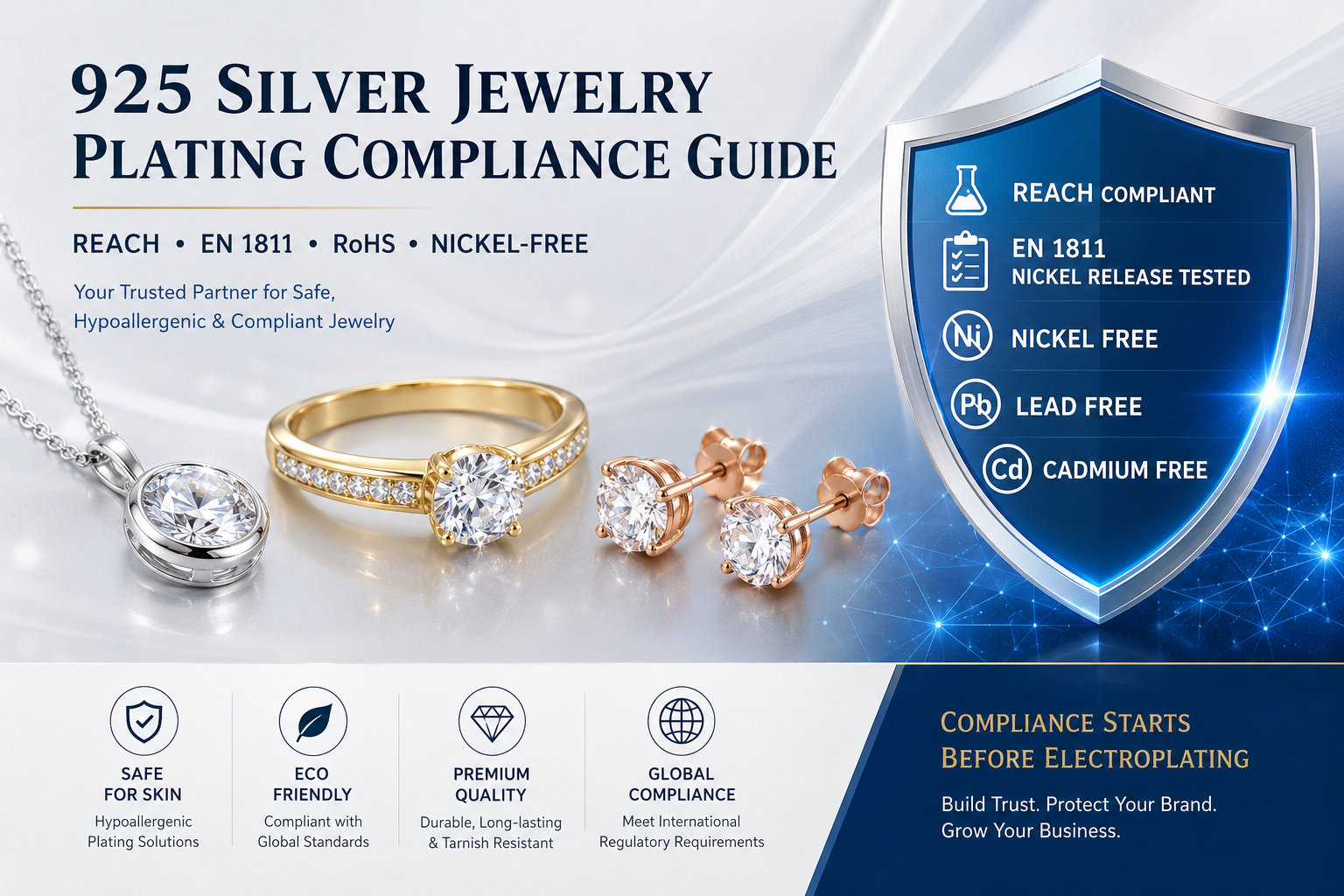
As consumers prioritize skin safety and environmental manufacturing standards, international jewelry brands now enforce strict electroplating compliance requirements alongside cosmetic finish quality.OEM and ODM buyers from EU, US, UK, Canada and Australia consistently request nickel-free, low heavy metal and hypoallergenic plating specifications before mass production orders are confirmed.
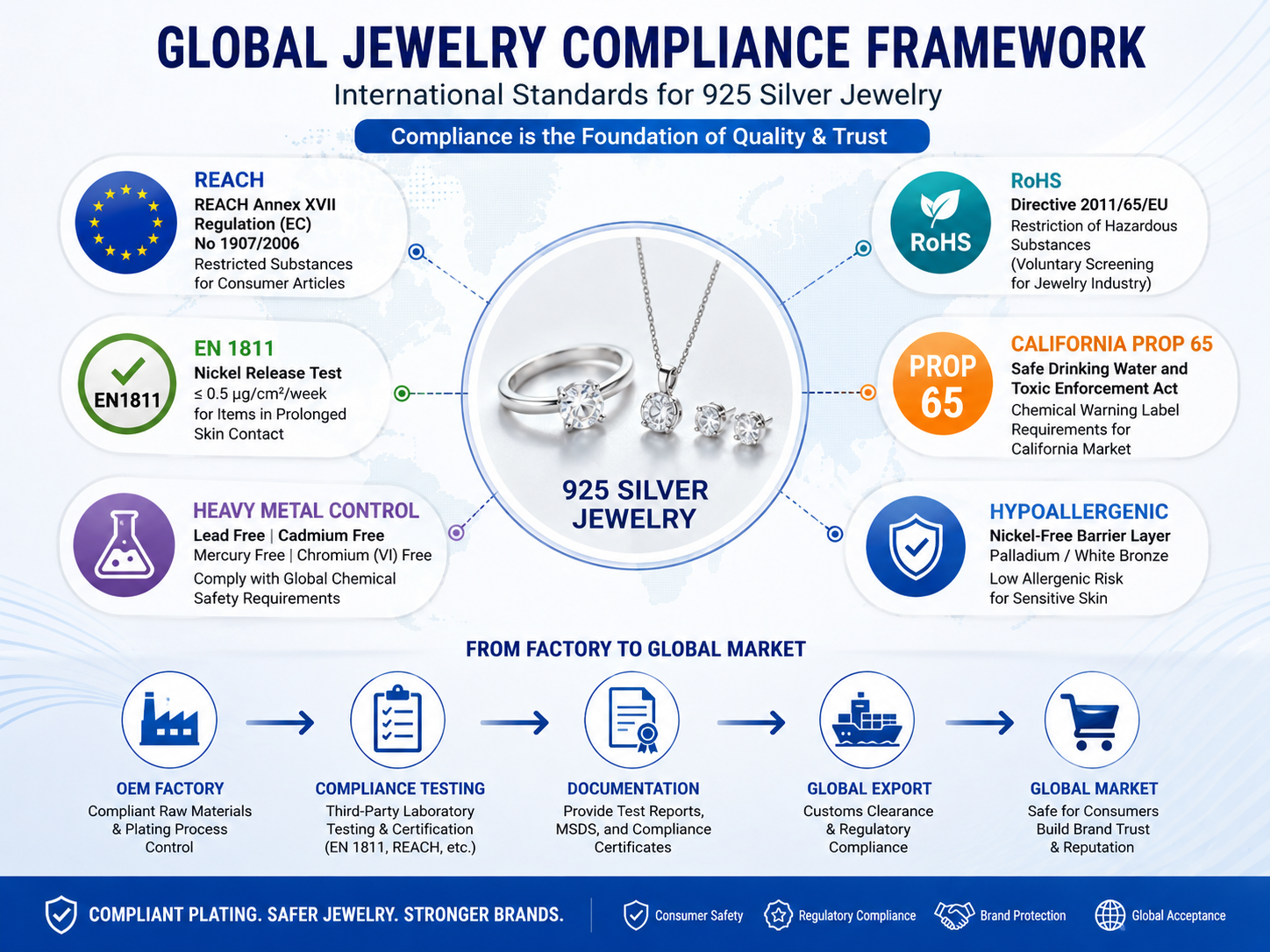
Many sourcing teams encounter confusion around overlapping regulatory terms: Nickel Free vs controlled nickel release, REACH Annex XVII restrictions, EN 1811 test limits, voluntary RoHS screening, and California Proposition 65 chemical labeling rules. Manufacturers also face technical tradeoffs when selecting barrier plating layers to satisfy global market standards.
This guide combines regulatory legal text, standardized test methods, factory plating stack engineering, and cross-market compliance checklists to help jewelry suppliers and brand buyers align plating processes with regional requirements.
Key questions covered in this resource:
1. What legal definitions separate nickel-free plating from regulated nickel release limits under EN 1811?
2. How do REACH Annex XVII, RoHS and Prop 65 apply differently to 925 sterling silver plated jewelry?
3. What barrier plating structures (nickel, palladium, white bronze) meet hypoallergenic and cross-border compliance rules?
4. How to verify third-party lab test reports to reduce customs detention and consumer allergy complaints
Why Jewelry Plating Compliance Matters
Electroplating layers directly control metal ion leaching from 925 sterling silver alloy, which contains copper as a hardening agent and accelerates heavy metal transfer during skin contact. Non-compliant plating systems create tangible business risks for both brands and manufacturers:
- Contact dermatitis and consumer product complaints
- Heavy metal leaching exceeding regulatory thresholds
- Accelerated tarnish, poor plating adhesion and short color lifespan
- Port customs inspection hold-ups or product seizure
- Mandatory product recalls and brand reputational damage
- Failed supplier audit qualification with large retail chains
Nearly all medium-to-large international jewelry brands require full third-party lab certification prior to production sign-off, with specific test standards tied to each target sales territory.
Core Standard Reference Index (Industry Standard Codes)
For consistent technical communication with labs and buyers, reference these official regulatory codes throughout all compliance documentation:
EN 1811: Standard test method for nickel release from items intended for prolonged skin contact
REACH Regulation (EC) No 1907/2006 Annex XVII: Restricted substances list for consumer articles
RoHS 2 Directive 2011/65/EU: Restriction of hazardous substances (originally for electronics, widely adopted voluntary jewelry screening)
California Proposition 65 (Safe Drinking Water and Toxic Enforcement Act of 1986)
EU Nickel Release Limit: ≤0.5 μg/cm²/week for prolonged skin contact jewelry (EN 1811 pass threshold)
What Does Nickel Free Mean in Jewelry Manufacturing?
A widespread industry misunderstanding equates “nickel free” with zero nickel content in all plating materials; this definition varies by market regulation and supplier process setup.
In manufacturing and regulatory contexts, nickel-free plating describes two distinct implementation approaches:
1. Zero-intent nickel processes: No nickel salt, nickel intermediate layers or nickel-based alloys introduced at any electroplating stage
2. Regulated nickel release compliant processes: May contain trace nickel within raw material impurities, but passes EN 1811 testing below the 0.5μg/cm²/week threshold
Nickel is the leading trigger of allergic contact dermatitis, so luxury and mass-market sensitive-skin brands typically eliminate traditional nickel barrier layers entirely rather than relying on post-production nickel release testing.
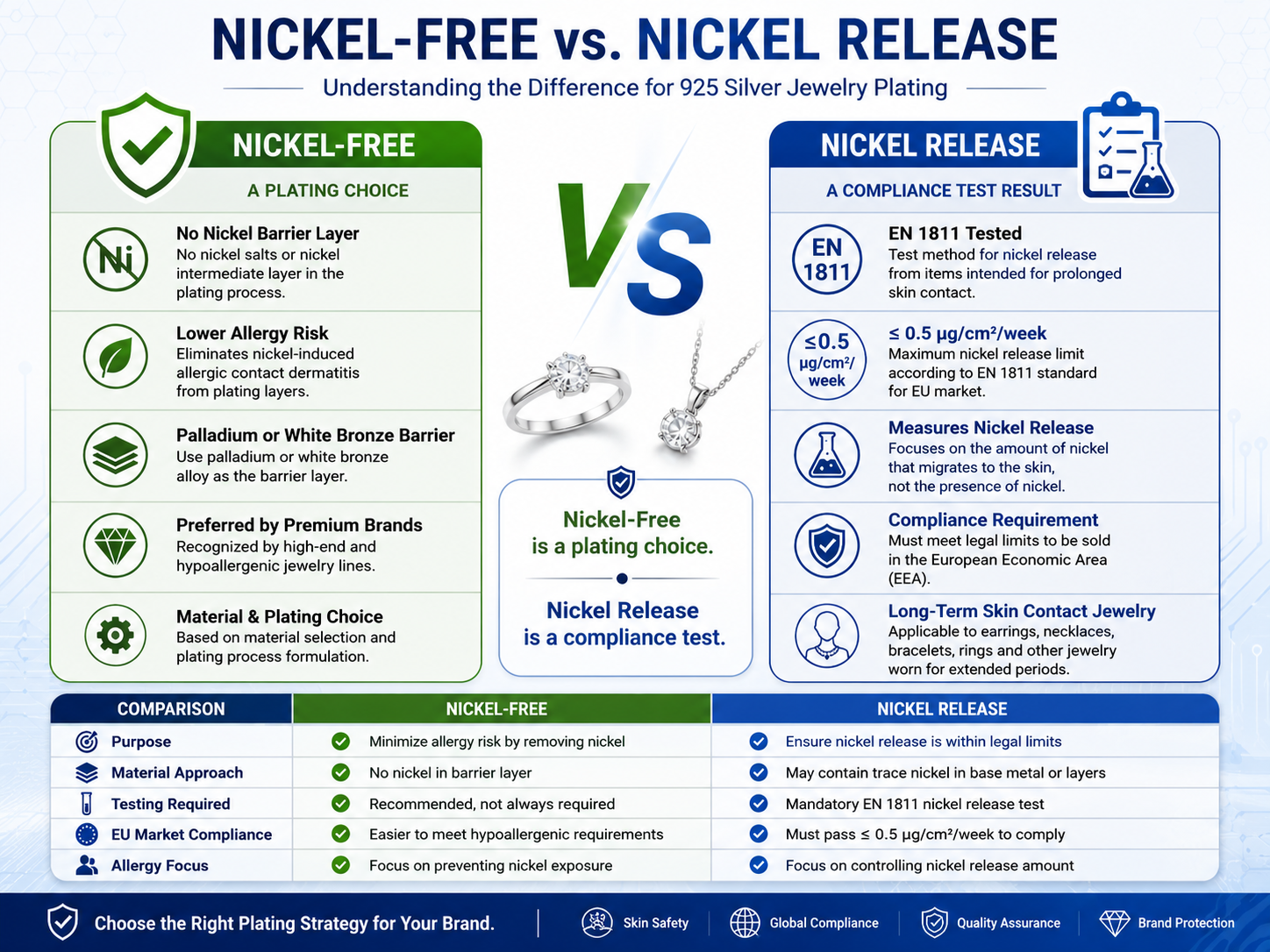
Nickel Free vs Nickel Release: Key Technical & Regulatory Distinction
|
Nickel Free Plating |
Nickel Release Compliance (EN 1811 Test Pass) |
|
Defined by plating material composition and process formula |
Defined by lab-measured metal ion leaching during wear simulation |
|
Barrier stack contains no nickel intermediate layer |
Base metal or underlayers may contain trace nickel impurities |
|
Preferred standard for EU, UK, Australian hypoallergenic branding |
Acceptable for low-risk markets only if below legal release limits |
|
Primary marketing claim for sensitive-skin jewelry lines |
Technical lab measurement result required for EU customs clearance |
|
Fully eliminates nickel allergy risk from plating layers |
Cannot guarantee zero nickel exposure from alloy base metal impurities |
Clarifying this distinction prevents miscommunication between buyers and plating factories during OEM technical specification confirmation.
REACH Annex XVII Requirements for Plated 925 Silver Jewelry
REACH (EC No 1907/2006) is the primary chemical safety framework governing consumer jewelry sold within the European Economic Area (EEA). It is not a voluntary standard for EU market placement.For electroplated sterling silver jewelry, the critical restrictions under REACH Annex XVII include:
- Nickel release limits enforced via EN 1811 testing for prolonged skin contact articles
- Strict limits on lead and cadmium total content within plating baths and finished products
- Restrictions on certain SVHC (Substances of Very High Concern) used in pre-plating cleaning and surface finishing chemicals
- Banned carcinogenic plating additives and phthalate brighteners
Compliance does not rely on a single test report; manufacturers must maintain batch records of plating bath formulations, raw material certificates and third-party EN 1811 analysis to demonstrate full REACH adherence during border inspections.
RoHS Application to Silver Jewelry (Voluntary Industry Adoption)
RoHS 2 2011/65/EU was legislated exclusively for electrical and electronic equipment and does not legally mandate testing for decorative jewelry.
However, most multinational retailers and brand partners include RoHS screening in their supplier qualification checklists as a voluntary material control requirement. Jewelry-focused RoHS testing typically screens plating and base alloys for restricted heavy metals: lead, cadmium, mercury, hexavalent chromium.
Factories offering RoHS reports position themselves as low-risk supply chain partners, even though the standard carries no legal enforcement for non-electronic jewelry goods.
California Proposition 65 Compliance for US Market Shipments
California Proposition 65 mandates visible consumer warning labels if finished goods leach listed toxic chemicals above defined safe harbor thresholds.For plated 925 silver jewelry, the primary monitored substances are lead, cadmium and certain plastic phthalates used in protective coating layers.
Many North American brands extend Prop 65 requirements to all inventory regardless of US sales territory, to avoid separate production lines for California-only stock. Suppliers must provide quantitative heavy metal content data to confirm whether warning labels are required for finished jewelry.
Lead Free & Cadmium Free Plating: Regulatory & Production Rationale
Historically, lead and cadmium additives improved casting fluidity and reduced plating material costs for budget jewelry lines. Scientific risk assessments link chronic heavy metal exposure to long-term health impacts, prompting global regulatory restrictions.
Responsible OEM silver jewelry manufacturers fully phase out lead/cadmium in plating solutions, pre-plating activators and base metal alloys to satisfy three overlapping requirements:
1. REACH Annex XVII total heavy metal content caps
2. Prop 65 safe harbor concentration limits
3. Brand internal sustainable manufacturing codes of conduct
Hypoallergenic Plating Systems & Factory Barrier Stack Technology
Hypoallergenic plating refers to engineered multi-layer electroplating stacks formulated to minimize metal ion transfer to skin. No plating material can eliminate all allergic reactions for every wearer, but these barrier structures deliver the lowest irritation risk for sensitive skin consumers.
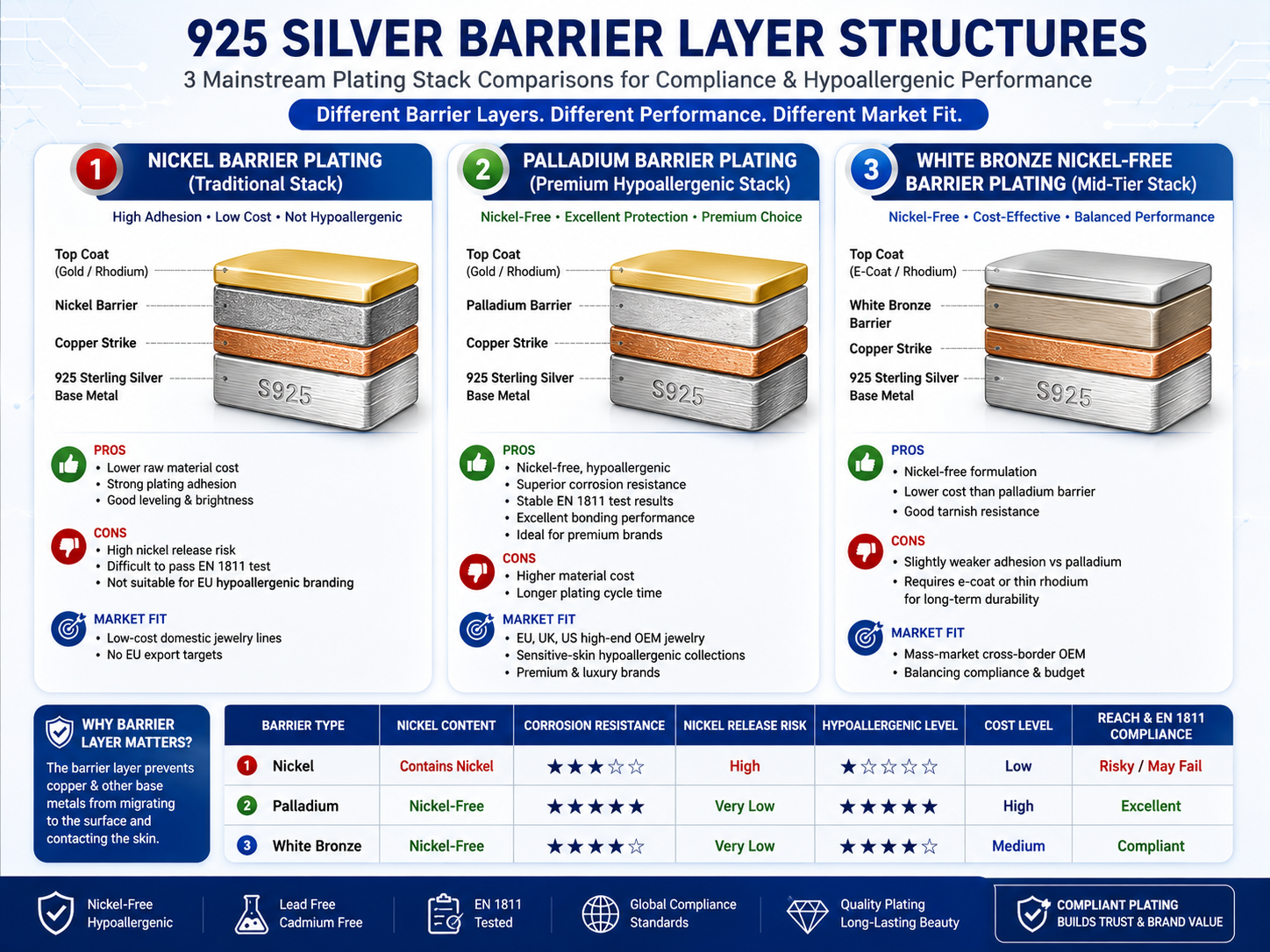
Below is factory technical breakdown of three mainstream barrier plating stacks applied to 925 sterling silver substrates:
1. Nickel Barrier Plating (Traditional Non-Hypoallergenic Stack)
Stack structure: Silver base → Copper strike → Nickel barrier → Gold/Rhodium top coat
- Pros: Low raw material cost, strong plating adhesion, uniform surface leveling
- Cons: High nickel release risk, fails strict EN 1811 testing, unsuitable for EU hypoallergenic branding
- Market fit: Low-cost domestic jewelry lines with no EU export targets
2. Palladium Barrier Plating (Premium Hypoallergenic Stack)
Stack structure: Silver base → Copper strike → Palladium barrier → Precious metal top coat (Gold/Rhodium)
- Pros: Zero nickel content, excellent corrosion resistance, stable EN 1811 test results, premium brand positioning
- Cons: Higher plating bath material cost, longer production cycle times
- Market fit: EU, UK, US high-end OEM jewelry, sensitive-skin hypoallergenic collections
3. White Bronze Nickel-Free Barrier Plating (Mid-Tier Cost-Effective Stack)
Stack structure: Silver base → Copper strike → White bronze alloy barrier → Protective E-coat / Rhodium top layer
- Pros: Nickel-free formulation, lower cost than palladium barrier, decent tarnish resistance
- Cons: Slightly weaker adhesion compared to palladium; requires supplementary thin e-coat for long-term durability
- Market fit: Mass-market cross-border OEM balancing compliance and production budget
Additional hypoallergenic finishing options: Pure rhodium direct plating, non-nickel hard gold plating, clear polymer E-coat sealing layers.
Why Global OEM Factories Transition to Palladium Barrier Layers
Nickel barrier plating was the industry standard for decades, but export-focused manufacturers increasingly switch to palladium intermediate layers to resolve cross-market compliance barriers:
- Eliminates nickel release failure risk under EN 1811 testing for EU shipments
- Superior corrosion resistance slows silver tarnish and extends plating lifespan
- Improved bonding between base copper strike and precious metal top coats
- Fully aligned with REACH Annex XVII hypoallergenic product specifications
- Supports premium brand marketing positioning without allergy consumer complaints
While palladium plating carries higher per-unit production costs, it eliminates costly post-production rework, failed customs shipments and product recall liabilities for export-focused OEM orders.
Regional Market Compliance Specification Cheat Sheet
|
Target Market |
Mandatory Regulatory Standards |
Recommended Plating Barrier Type |
|
European Union / EEA |
REACH Annex XVII, EN 1811 nickel release ≤0.5μg/cm²/week |
Palladium / White Bronze Nickel-Free Barrier |
|
United States |
Voluntary RoHS screening, California Prop 65 labeling rules |
Nickel-Free Barrier + Lead/Cadmium Free Baths |
|
United Kingdom |
REACH UK Annex XVII, EN 1811 nickel testing |
Palladium Barrier Preferred |
|
Canada |
Canadian Nickel Release Consumer Product Safety Rules |
Nickel-Free Barrier Layers Required |
|
Australia |
National heavy metal limits, hypoallergenic marketing restrictions |
White Bronze or Palladium Barrier |
Critical factory note: Individual brand buyers may impose internal standards stricter than local government regulations. All plating stack specifications must be confirmed in writing before mass production begins to avoid redesign delays.
How OEM Buyers & Factories Verify Plating Compliance
Qualified silver jewelry electroplating manufacturers provide full third-party laboratory documentation upon customer request. Standard compliance validation files include:
- EN 1811 Nickel Release Test Report
- REACH Annex XVII restricted substance screening certificate
- RoHS heavy metal content analysis (voluntary)
- Prop 65 chemical concentration test data for US orders
- Raw plating bath material MSDS (Material Safety Data Sheets)
- Batch manufacturing records for barrier layer plating formulations
Requesting full certification prior to sample production eliminates compliance failures that trigger customs detention, order hold or consumer product complaints post-delivery.
Frequently Asked Questions (12 Questions)
Q1: Does nickel-free plating guarantee zero skin allergies for all wearers?
A: No. Nickel-free barrier layers eliminate nickel-induced dermatitis risks from plating, but 925 silver base metal contains copper, and rare individuals carry allergies to palladium, rhodium or gold metals. Hypoallergenic plating drastically reduces irritation risk but cannot promise 100% allergy-free wear for every consumer.
Q2: What is the official EN 1811 nickel release limit for EU jewelry?
A: EN 1811 mandates a maximum nickel release rate of 0.5 μg/cm² per week for jewelry intended for prolonged direct skin contact; plating stacks exceeding this threshold fail REACH Annex XVII compliance for EU market sales.
Q3: Can gold-plated sterling silver jewelry still contain nickel?
A: Yes. Conventional low-cost gold plating processes use a nickel intermediate barrier layer underneath gold unless the factory explicitly adopts nickel-free palladium or white bronze plating stacks. Buyers must specify nickel-free requirements in OEM technical sheets.
Q4: Is REACH compliance legally required for silver jewelry sold in Europe?
A: REACH (EC No 1907/2006) Annex XVII restrictions are legally mandatory for all consumer jewelry placed on the EEA market; non-compliant products face customs seizure and import fines.
Q5: Is RoHS a legal requirement for plated 925 silver jewelry?
A: RoHS legislation only applies to electrical and electronic goods. It carries no legal enforcement for decorative jewelry, though most global brands demand voluntary RoHS heavy metal screening as part of supplier audits.
Q6: What plating barrier is the most cost-effective nickel-free option for mass OEM orders?
A: White bronze alloy barrier plating delivers balanced compliance and lower production costs than palladium layers, ideal for mid-budget cross-border jewelry collections. Premium hypoallergenic lines use palladium barrier stacks.
Q7: Does rhodium plating count as hypoallergenic for sensitive skin?
A: Solid rhodium top plating is widely recognized as one of the most skin-safe precious metal finishing layers, but compliance still depends on the intermediate barrier layer underneath the rhodium coat. A nickel barrier under rhodium will still fail EN 1811 nickel release testing.
Q8: What triggers California Proposition 65 warning labels on silver jewelry?
A: Warning labels are required if lab testing detects lead, cadmium or regulated phthalates above Prop 65’s established safe harbor thresholds within plating, alloys or protective coating layers.
Q9: Can nickel-free white bronze barrier plating pass full REACH Annex XVII testing?
A: Yes, properly formulated lead-free, cadmium-free white bronze plating baths consistently meet REACH Annex XVII and EN 1811 nickel release standards for EU export orders.
Q10: Why do customs seize plated silver jewelry shipments?
A: The most common detention reasons include failed EN 1811 nickel release testing, unreported lead/cadmium content missing REACH documentation, and missing Prop 65 warning labeling for US-bound inventory.
Q11: What SVHC substances under REACH impact jewelry electroplating?
A: Restricted SVHC chemicals relevant to plating include certain chromate pre-treatment cleaners, toxic brightening additives and high-concentration phthalate sealants; certified factories substitute these with compliant finishing chemistry.
Q12: Can manufacturers switch plating barrier layers mid-order to fix compliance issues?
A: Barrier stack changes require new plating bath preparation, sample testing and re-certification, which creates significant production delays. All compliance and plating specifications should be finalized during OEM sample development before mass production launches.
Final Thoughts for OEM Jewelry Manufacturers & Brand Buyers
Selecting compliant electroplating stacks for 925 sterling silver demands alignment of three core factors: target market regulatory rules, sensitive-skin hypoallergenic branding positioning, and factory production cost constraints.
Understanding formal standards including REACH Annex XVII, EN 1811 nickel testing, Prop 65 labeling and voluntary RoHS screening minimizes cross-border compliance risks, reduces consumer allergy complaints, and builds long-term supply chain trust with global retail partners.
For all custom OEM and ODM silver jewelry projects, confirm plating barrier structure, regulatory testing requirements and third-party certification deliverables during initial design sampling. Early compliance alignment avoids costly batch rework, failed customs clearance and order delays in later production stages.
B2B CTA Section
If you require custom nickel-free palladium or white bronze barrier plating for your 925 silver OEM collection, or need full REACH/EN 1811 compliance testing support for global market shipments, connect with our jewelry technical team to review your plating specification sheet and receive factory compliance documentation samples.
Related Reading: 925 Silver Plating Options | Different Plating Processes | Why Plating Fades
 anya907888