



Which Jewelry Test Report Actually Matters? A Buyer‘s Guide to AnchorCert, REACH, Prop 65, COC and RoHS
Ask three suppliers for "compliance documents" and you will get three different stacks of paper. One sends a nickel-release report. One sends a certificate with a lab logo. One sends a RoHS report for a plain silver ring. None of them is lying — and none of them has answered the question that actually matters, which is where are you selling.
Key takeaways
- Destination decides the document. There is no universal jewelry compliance certificate. The EU, the US and the UK each demand a different evidence set.
- The EU baseline is REACH Annex XVII — cadmium, nickel release and lead, proven by test reports — plus GPSR, which requires an EU-established responsible person.
- The US baseline is state law plus, for children‘s items, federal CPSIA — and the CPC can only be issued by the importer, never by the factory.
- A certificate is a conclusion; a report is the data behind it. Retail audits generally want the report.
- RoHS is usually the wrong request for conventional jewelry — it governs electrical equipment.
- Reports describe submitted samples, not permanent product status. Change an alloy source or plating stack and the evidence needs refreshing.
Jump to: why there is no universal certificate · the comparison table · selling into the EU · selling into the US · selling into the UK · if you could only have one · how to read a report · how we work · FAQ
Why There Is No Universal Jewelry Certificate
Buyers often ask for "the jewelry compliance certificate" as if one document existed. It does not, and the reason is structural: each jurisdiction regulates a different thing, in a different way, with a different proof format.
The EU restricts specific substances in articles and expects laboratory evidence. California operates two parallel statutes — one sets content limits, the other governs warning labels. The US federal system regulates children‘s products through a certification chain that begins with the importer, not the manufacturer. The UK has copied the EU rulebook and is now free to diverge from it.
A supplier who hands over one document for all of these is either guessing, or hoping you will not read it.
The correct first question is never "what certificates do you have?" It is "here is where I sell and who I sell to — what evidence do I need?"
The Comparison Table
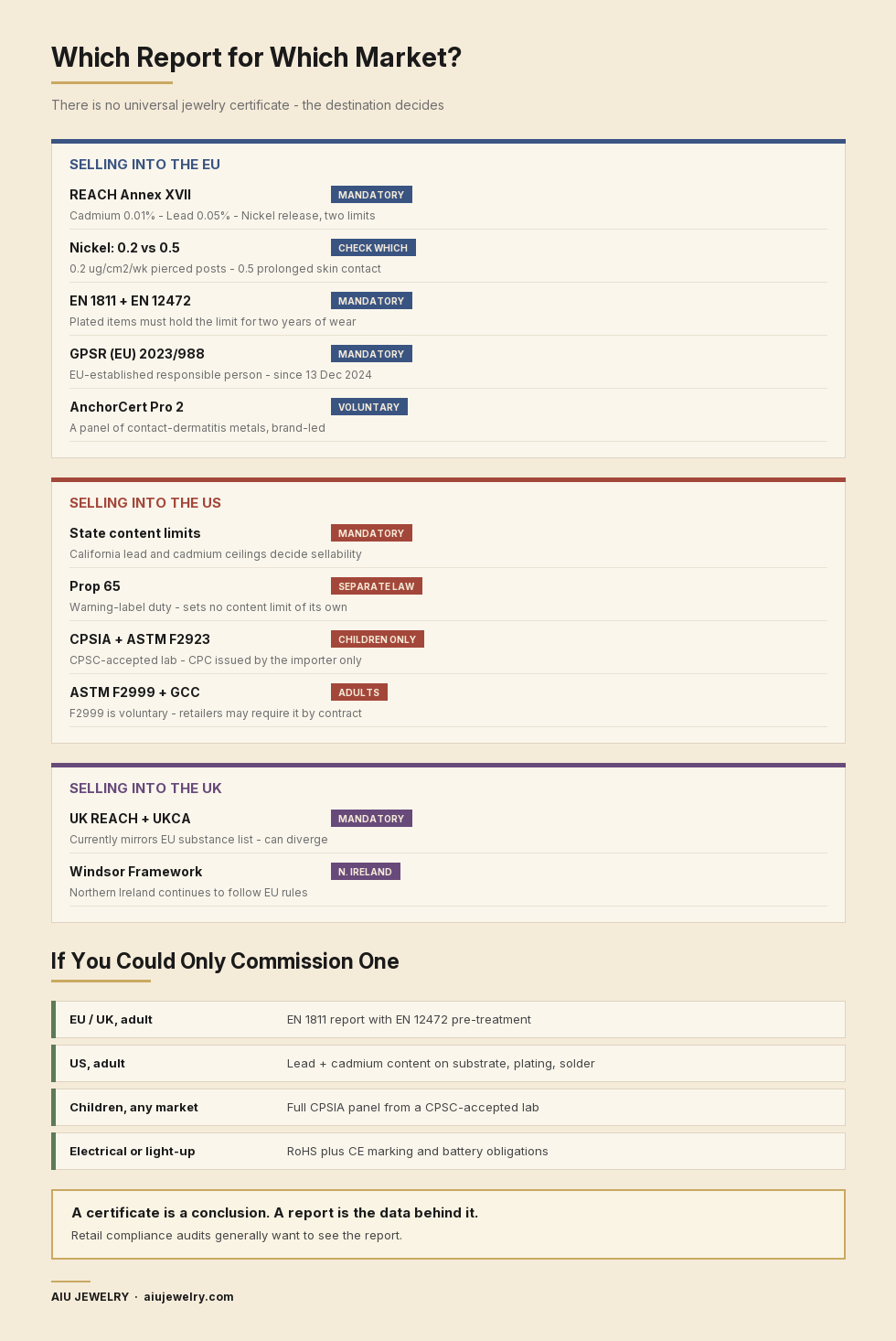
This is the whole cluster in one view. Each row links to a full breakdown.
| Requirement | Market | What it covers | Mandatory? | Full guide |
|---|---|---|---|---|
| REACH Annex XVII | EU | Cadmium (Entry 23), nickel release (27), lead (63) | Yes — baseline for all jewelry | Entries 23, 27 and 63 explained |
| EN 1811 nickel release | EU / UK | The test method behind Entry 27 | Yes for skin-contact items | How to read the report |
| GPSR (EU) 2023/988 | EU | General product safety; EU-established responsible person, traceability and labelling | Yes — applies since 13 Dec 2024 | Regulation text (EUR-Lex) |
| AnchorCert Pro 2 | EU / UK | A panel of metals associated with contact dermatitis | No — voluntary, brand-led | What the programme covers |
| California limits + Prop 65 | US (CA) | Lead and cadmium content; separate warning-label duty | Yes to sell in California | Two laws, not one |
| CPSIA + ASTM F2923 | US federal | Children‘s jewelry: lead, cadmium, small parts, sharp points | Yes for children‘s items | Testing, eFiling and costs |
| Certificate of Compliance | All | A conclusion drawn from underlying test data | Commercial, not statutory | COC vs test report |
| RoHS 2011/65/EU | EU / UK | Restricted substances in electrical equipment | Only if the item is electrical | When it does not apply |
On the figures in this table: thresholds and scope are revised periodically. Verify the current official text before relying on any number here for a commercial decision — links to the primary sources are given in each section below.
Selling Into the EU
Your baseline is REACH Annex XVII. Three entries govern jewelry: cadmium at 0.01% content (Entry 23), nickel release (Entry 27), and lead at 0.05% content (Entry 63). Ask for laboratory reports against each entry that applies to your range.
Entry 27 sets two different nickel limits, and the stricter one is easy to miss.
- 0.2 μg/cm²/week — for post assemblies inserted into pierced ears or other pierced body parts. This is the tighter limit, and it is the one that applies to studs, ear posts and piercing jewelry.
- 0.5 μg/cm²/week — for articles in direct and prolonged skin contact: earrings, necklaces, bracelets, chains, anklets, rings, watch cases and straps.
A supplier quoting only "0.5" for an ear-post range has cited the wrong limit. Check which one your report was tested against.
Two further points decide whether that evidence survives an audit.
Nickel is measured as release, not content. A high-nickel alloy can pass if the surface is engineered correctly; a low-nickel alloy can fail if the plating wears through. This is why the pre-treatment method matters — an EN 1811 result without EN 12472 wear simulation describes a product that has never been worn.
Coated items carry a durability duty. Entry 27(c) requires that a non-nickel coating keeps release below the limit for at least two years of normal use. That is why plated pieces need the EN 12472 pairing: a report on a pristine surface says nothing about year two. If a report covers a plated item but shows no pre-treatment, treat it as an incomplete answer rather than a pass. The consolidated Annex XVII text is published here.
REACH is not the whole EU picture. The General Product Safety Regulation — (EU) 2023/988, applicable since 13 December 2024 — requires that no product be placed on the EU market unless there is an economic operator established in the Union responsible for it, and that the responsible person‘s contact details accompany the product. For a brand already established in the EU this is usually satisfied internally; for a non-EU seller shipping direct, it is a gating requirement that no test report addresses. Chemical compliance and GPSR are separate obligations, and passing one does not discharge the other.
Beyond the legal floor, some brands add AnchorCert Pro 2, which screens a panel of metals associated with contact dermatitis rather than nickel alone. It is voluntary. It is worth considering if your positioning rests on sensitive-skin claims — although note that no test programme licenses the word "hypoallergenic", which has no regulatory definition.
Selling Into the US
The US has no single national jewelry standard for adult products. Instead you face state content laws, and — for children‘s items — a federal certification regime.
State level. California is the market driver, and it operates two separate statutes that are routinely confused. One sets lead and cadmium content limits that determine whether an item may be sold at all. Proposition 65 is a different instrument: a warning-label law that sets no content limits of its own. Other states add their own layers — New York, for example, imposes a labelling duty in a defined lead band rather than a lower content ceiling.
The workable approach is to specify to the union of your target states‘ requirements, then verify by test. Our California guide sets out how the two statutes interact.
Federal level, children‘s products. If the item is designed or intended primarily for children 12 and under, CPSIA applies: third-party testing at a CPSC-accepted laboratory, ASTM F2923 for mechanical and physical hazards, and a Children‘s Product Certificate.
The CPC point that costs importers money: the certificate must be issued by the importer of record, not the factory. A supplier offering to "provide your CPC" has misread the rule. What a factory can legitimately supply is the underlying test data and support in assembling the eFiling data elements.
CPSC eFiling became mandatory on 8 July 2026. Full detail, including realistic test-panel costs, is in our children‘s jewelry guide.
Adult jewelry: what a GCC is, and when you actually need one. The federal counterpart to the CPC for non-children‘s products is the General Certificate of Conformity. It is required only where the product is subject to a CPSC-enforced safety rule — it is not a blanket requirement for all adult jewelry, and unlike the CPC it does not mandate third-party lab testing.
Separately, many US retailers and marketplaces ask adult ranges to be tested against ASTM F2999, the consumer safety specification for adult jewelry. Keep the two apart when you plan a budget: ASTM F2999 is a voluntary consensus standard, not a federal mandate. If a buyer requires it, that is a contractual requirement of the buyer, and it should be priced and scheduled as such rather than treated as a legal precondition for import.
Selling Into the UK
Great Britain retained the EU restrictions as UK REACH and marks conformity with UKCA where marking applies. Northern Ireland continues to follow EU rules under the Windsor Framework.
GPSR does not apply to Great Britain. The EU general product safety regime discussed above is an EU instrument; Great Britain continues to operate its own General Product Safety Regulations 2005. Northern Ireland is the exception — under the Windsor Framework it follows the EU regime, and the UK government issues separate general product safety guidance for Great Britain and for Northern Ireland for exactly this reason. If you ship to both, treat them as two destinations, not one.
In substance terms the two chemical regimes currently align, so an EU-compliant range is normally a UK-compliant range. The risk is drift. The two lists are maintained separately and can diverge, which means a document set assembled years ago should not be assumed current. Check the entry versions your reports cite rather than the report date alone.
If You Could Only Have One Document
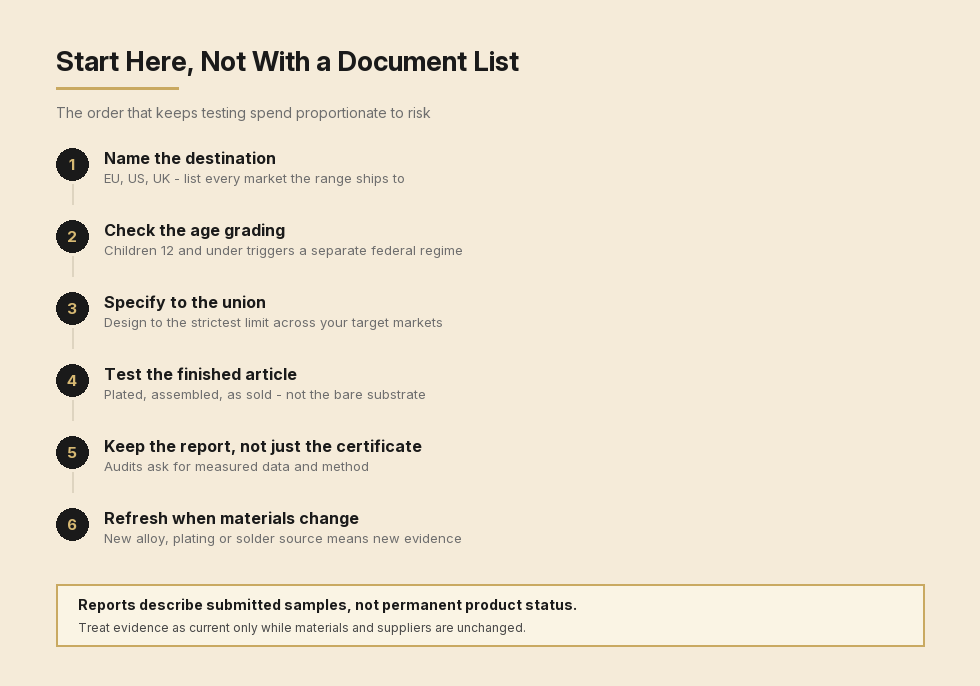
Compliance budgets are finite, and first orders rarely fund a full test programme. If you can commission only one piece of evidence, choose by destination:
- EU or UK, adult jewelry → an EN 1811 nickel-release report with EN 12472 pre-treatment, on the finished plated article. Nickel is the most commonly enforced restriction on skin-contact items, and the pre-treatment is what makes the result defensible.
- US, adult jewelry → a lead and cadmium content report covering the substrate, plating and any solder, tested against your target states‘ limits.
- Children‘s jewelry, any market → the CPSIA panel from a CPSC-accepted laboratory. This is not optional and cannot be substituted with a general chemical report.
- Electrical or light-up pieces → RoHS becomes relevant, but so do CE marking and battery obligations. Map the full set before tooling.
One caution on format. A certificate is a conclusion; a report is the data supporting it. Retail compliance audits generally want to see the data, so a certificate alone is a thin file — see what a COC does and does not prove.
How to Read a Test Report in Five Minutes
Most disputes we see are not about failed tests. They are about reports that were never read closely. Five checks catch almost everything:
- Does the sample description match what you are buying? Compare material, plating and colourway against your purchase order. A report on a rhodium-plated sample does not cover the gold-plated version of the same style.
- Which limit was applied? For nickel, confirm whether the result was assessed against 0.2 or 0.5 μg/cm²/week. The right number depends on whether the item is a pierced-body post or general skin contact.
- Is the method current? Nickel release should cite EN 1811:2023, or the edition current at the time of testing. Reports still citing the superseded EN 1811:2011+A1:2015 are a signal that the file has not been refreshed.
- For plated items, is EN 12472 present? Without the wear-and-corrosion pre-treatment, the result describes an unworn surface and does not address the two-year durability duty.
- Is the laboratory accredited for that method, and when was the report issued? Look for ISO/IEC 17025 accreditation covering the specific test, and check the date against your current production run rather than the date you first received the file.
If any of the five is unclear, the correct action is to ask the supplier for clarification in writing rather than to file the document and move on.
How We Handle This
At AIU Jewelry we start from the destination, not the document list. Tell us the markets, the age grading and the retail channel, and we map which evidence applies before sampling — so the testing cost is visible while the design can still change.
Reports we currently hold include TSNH00597757-1 (Intertek, 925 silver), (8526)012-0684 (BV, 925 silver), SZHH01824690 (SGS, Prop 65, 316L), SZHH01783169 (SGS, REACH, 316L) and CANEC2100348201 (SGS, RoHS). Formats are visible on our certification and honor page. These are reference files held against past production; for your own order, ask us for the current valid report covering your specific materials and finish rather than relying on a reference number quoted on a web page.
Two things we will not do. We will not issue a Children‘s Product Certificate, because only the importer of record can — we supply the test data behind it and help assemble the eFiling elements. And we will not sell you a report you do not need; if a request does not apply to your product, we will say so.
Underpinning production is a 0.03% final-inspection defect rate (based on internal QC records over the past 12 months; an internal quality metric, not independently audited and not a legally binding guarantee).
On report validity: laboratory reports and the certificates derived from them apply only to the samples submitted, and are representative of ongoing production batches rather than permanently valid documents. Changing alloy sources, plating stacks or component suppliers requires fresh testing. Always request the latest valid copies for your specific order before shipment.
Note: this article is general information about market requirements, not legal advice. Regulations and their thresholds are revised periodically — verify current text before relying on any figure. Importers and brand owners should confirm their own obligations with qualified counsel.
Frequently Asked Questions
Is there one certificate that covers every market?
No. The EU regulates substances in articles under REACH, US states set their own content limits, and US federal law governs children‘s products through a separate certification chain. A single document claiming to cover all of them is a commercial summary, not a compliance position.
My supplier sent a certificate instead of a report. Is that enough?
It depends on who is asking. A certificate states a conclusion; the report carries the measured data, the method and the sample description. Retail compliance audits generally want the report, so ask for both and check that the certificate actually references the report it summarises.
Do we need REACH SVHC screening as well as the Annex XVII limits?
They are two different mechanisms and it is worth knowing which one a buyer means. Annex XVII sets hard restrictions — cadmium, nickel release, lead — that a product must meet to be placed on the market. The Candidate List of substances of very high concern works differently: it triggers information and notification duties when an SVHC is present above 0.1% by weight in an article, and the list is expanded periodically. Most conventional jewelry ranges are controlled through Annex XVII, but brands running their own restricted-substance programmes often ask for SVHC screening on top. Treat that as a buyer requirement to scope and price, and confirm which substances and which list version they expect.
Do I need REACH testing if I only sell in the US?
Not as a legal matter. However, several REACH thresholds are close to or stricter than common US state limits, so an existing REACH data set often supports a US position with limited extra work. The reverse is less often true.
How long does a test report stay valid?
Reports do not carry a statutory expiry, but they describe the samples submitted at a point in time. Treat a report as current only while materials, suppliers and surface treatment are unchanged. Many retailers ask for evidence refreshed on a defined cycle regardless.
Who issues the Children‘s Product Certificate?
The importer of record for goods entering the US. A manufacturer supplies the third-party test results the certificate relies on, but cannot issue the CPC itself.
Does GPSR require testing, and can our factory be the responsible person?
GPSR does not itself prescribe a test panel — it is a general safety and traceability regime that sits alongside REACH. The responsible person must be an economic operator established in the EU, so a manufacturer outside the Union cannot fill that role. Brands typically use their own EU entity, their importer, or an appointed authorised representative.
Is ASTM F2999 mandatory for adult jewelry in the US?
Not as federal law — it is a voluntary consensus standard. Many US retailers and marketplaces require it contractually, which makes it a commercial obligation rather than a legal one. Budget for it when a buyer asks, but do not assume every US shipment needs it.
We sell on marketplaces that demand RoHS. What do we do?
For conventional jewelry the accurate answer is that RoHS does not apply, supported by the REACH documentation that does. Most marketplace forms are generic multi-category templates and a reasoned explanation is normally accepted.
Tell us your target market and we will map the evidence you actually need. Send the destination countries, whether any item is graded for children, and your retail channel. We will come back with the required tests, the ones you can skip, and what the programme realistically costs. Response within 24 hours, under NDA.
Last updated: August 2026. Reviewed by the AIU Jewelry compliance team. Thresholds and scope verified at time of writing against the primary sources linked in this article: REACH Annex XVII consolidated text, GPSR (EU) 2023/988 and CPSC certification guidance.
 anya907888