



What Is a Certificate of Compliance? How a COC Differs from a Test Report — and Why Retailers Ask for Both
.jpg)
Ask a supplier for compliance documentation and you will get one of two things: a certificate of compliance, or a test report. They are not interchangeable, they answer different questions, and a buyer who accepts the wrong one ends up unable to prove anything when a retailer audits the file.
A certificate of compliance (COC) is a one-page conclusion document stating that a tested product meets a named regulation or standard — distinct from the multi-page test report that supplies the measured data behind it.
Key takeaways
- A test report carries data. A COC carries a conclusion. The report shows measured values; the certificate states that those values meet a named requirement.
- A COC issued by a laboratory is not the same as a supplier‘s own declaration. Third-party certificate, first-party declaration — different evidential weight entirely.
- They are usually one piece of evidence, not two. A COC and the full report behind it normally share a reference number. Any supplier presenting them as two separate proofs is padding the file.
- For coated jewelry, the pre-treatment decides whether the result means anything. Under EN 12472:2020, nickel-release testing runs after simulated wear and corrosion — testing a fresh surface tells you nothing about month six.
- Check the version numbers. The current harmonised methods are EN 12472:2020 and EN 1811:2023. A recently issued report still citing superseded editions is a signal in itself.
- Ask which one your buyer actually needs. Retail compliance teams file COCs; technical and QA teams want the underlying report.
Jump to: what a COC is · COC vs test report · three documents people confuse · why pre-treatment matters · what to ask us for · FAQ
Certificate of Compliance for Jewelry: What the Document Actually Is
A certificate of compliance — also written certificate of conformity, and abbreviated COC or CoC — is a conclusion document. It names a product, names a requirement, and states that the first satisfies the second.
A typical jewelry COC from an accredited laboratory carries:
- The sample description — material, item type, sometimes a client reference
- The standard or regulation assessed against
- The date of issue and a unique reference number
- A conclusion line — typically "complies" or "pass"
- The issuing laboratory and its accreditation
What it usually does not carry is the measured numbers. That is the point of the format — it is designed to be filed, forwarded and checked quickly, not analysed.
Key definitions at a glance
- Certificate of Compliance (COC) — a third-party conclusion document stating a product meets named requirements. Usually one page.
- Test Report — raw measured data: values, methods, detection limits, per-component results, from an accredited laboratory. Often multiple pages.
- Declaration of Conformity (DoC) — a first-party supplier statement issued under ISO/IEC 17050. Legitimate, but not third-party evidence.
COC vs Test Report: The Difference That Matters Commercially
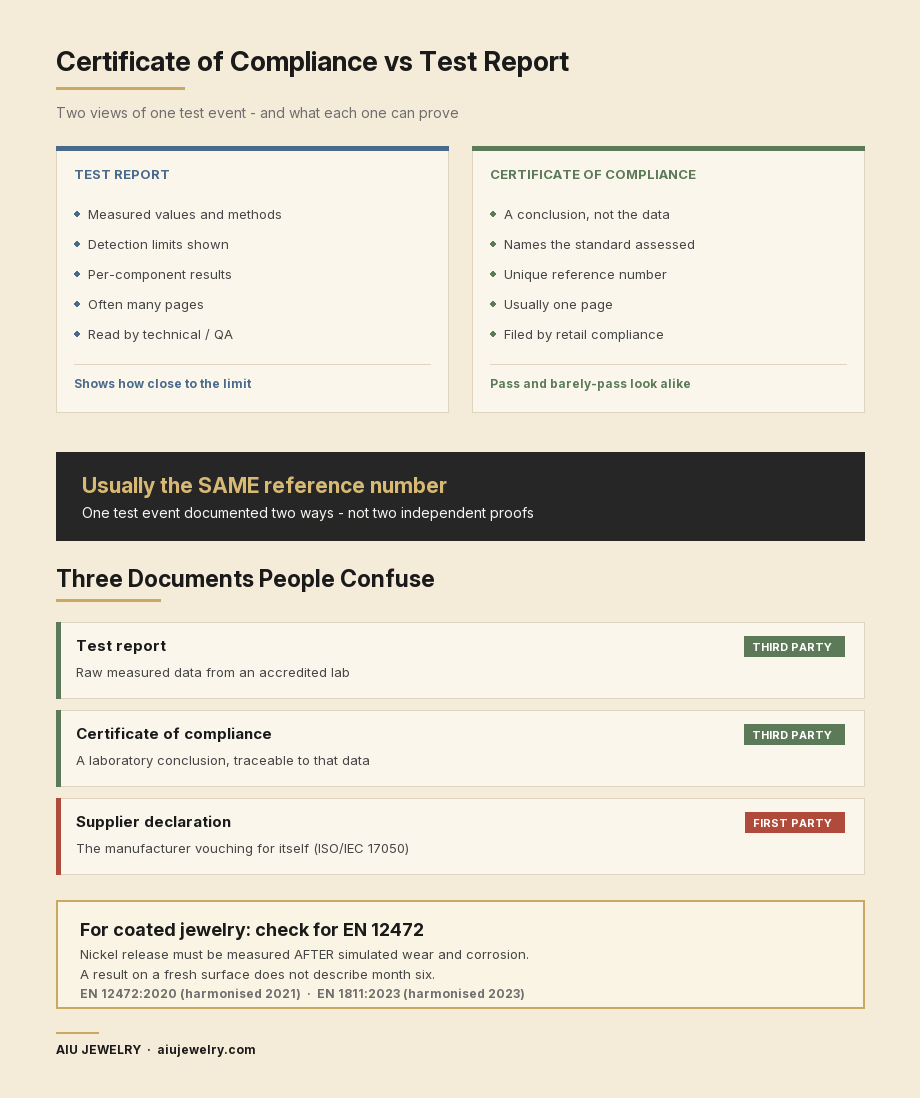
| Test report | Certificate of compliance | |
|---|---|---|
| Contains | Measured values, methods, detection limits, per-component results | A conclusion against a named requirement |
| Answers | "What did the lab actually find?" | "Does this product pass?" |
| Length | Often many pages | Usually one page |
| Used by | Technical, QA, product development | Retail compliance, buying teams, customs files |
| Lets you verify margin | Yes — you see how close to the limit | No — pass and barely-pass look identical |
That last row is the one buyers underestimate.
A COC tells you the product passed. It does not tell you whether it passed at 10% of the limit or at 98% of the limit. Those two products carry completely different risk when the alloy source shifts slightly on the next batch.
If you are choosing between suppliers, or qualifying a new material, the report is the document that lets you judge. If you are filing evidence for a retailer, the certificate is the document they want. Serious programmes keep both — and understand that they are two views of one test event, not two tests.
A certificate without a traceable report is a conclusion with no evidence — and a report without a certificate is data no compliance team will file.
The honest bit most suppliers skip
A COC and the detailed report behind it normally carry the same reference number, because they describe the same laboratory work. One is the summary, the other is the evidence.
So when a supplier sends you a certificate and a report and implies you are looking at two independent proofs, check the numbers. If they match, you have one test event documented two ways. That is completely legitimate and genuinely useful — but it is one piece of evidence, and a supplier who blurs that is telling you something about how they handle documentation generally.
Three Documents People Routinely Confuse
- Test report — third party. Raw measured data from an accredited laboratory.
- Certificate of compliance — third party. A laboratory‘s conclusion, traceable to that data.
- Supplier‘s declaration of conformity — first party. The manufacturer‘s own statement, issued under the ISO/IEC 17050 framework. It may be entirely accurate and it is a normal part of trade, but it is the supplier vouching for itself.
All three can appear on the same letterhead-heavy PDF and look equally official. The distinction is who is making the claim. When a retailer asks for "a certificate", establish which of the three they mean before you promise anything — and when a supplier offers you "certification", establish which one you are being given.
A related trap: certification of the factory is not certification of the product. An ISO 9001 certificate says a quality management system was audited. It says nothing about the lead content of a specific pendant.
Why the Pre-Treatment Decides Whether Your Certificate Means Anything
For plated and coated jewelry — which is most fashion jewelry — there is a technical point that separates a meaningful certificate from a decorative one.
Nickel release under REACH Entry 27 has to stay below the limit throughout the article‘s normal expected lifetime, not just when it leaves the factory. A freshly plated surface will almost always pass. The question is what happens once the coating wears.
That is what EN 12472 exists for. It is a method for simulating accelerated wear and corrosion, applied before nickel release is measured under EN 1811.
Both reference methods were updated recently, and quoting the right version is a small signal worth getting right when you request documentation:
- EN 12472:2020 — the wear and corrosion simulation. Harmonised by the European Commission on 20 April 2021, replacing EN 12472:2005+A1:2009.
- EN 1811:2023 — the nickel release measurement itself. Harmonised by the European Commission on 20 December 2023 (Commission Communication C/2023/1604, Official Journal), replacing EN 1811:2011+A1:2015.
A report citing a superseded version is not automatically worthless. But on a document issued well after those dates, it tells you how closely the laboratory — or the supplier commissioning it — tracks the current framework.
For a coated article, a nickel-release certificate without abrasion pre-treatment describes a product that does not exist after a month of wear. Check whether EN 12472 appears alongside EN 1811 on the document — on a plated piece, its absence is the single most useful thing you can notice.
This is why two certificates that both say "complies with EN 1811" can carry very different weight. If you want to read a nickel-release document line by line, we cover that in our walkthrough of a 925 silver nickel-release report, and the underlying restriction itself in our breakdown of REACH Annex XVII entries 23, 27 and 63.
What to Ask Us For — and What You Will Get
At AIU Jewelry — an OEM/ODM manufacturer supplying European and North American jewelry brands — we work backwards from what your retail compliance team will demand, and the request becomes precise.
"Do you have a certificate, or a report?"
Both, from the same test events. Our 925 sterling silver line is covered by Bureau Veritas certificate (8526)012-0684, and our 316L stainless steel line by (8526)012-0683. Each certificate is backed by the detailed report carrying the same reference — we will send you the certificate for your file and the report for your technical review, and we will tell you plainly that they document the same testing.
"Was the coated product abrasion-tested?"
This is the question we would want a buyer to ask us. For plated constructions we specify nickel-release testing with EN 12472 wear-and-corrosion pre-treatment, because a result on an unworn surface does not describe what your customer will be wearing in month six.
"Will the documentation match what my retailer files?"
Retail compliance teams file conclusions; technical teams read data. We supply both formats rather than making you choose, and we identify which of your target markets each document actually covers — European nickel documentation does not cover the US, and vice versa. For children‘s pieces the US stack runs through CPSIA and ASTM F2923 instead, which we cover in our guide to children‘s jewelry testing and certification.
Behind this sits our documented process control: a 0.03% final-inspection defect rate (based on internal QC records over the past 12 months; an internal quality metric, not independently audited and not a legally binding guarantee). Document formats are visible on our certification and honor page.
On report validity: lab reports and the certificates derived from them apply only to the samples submitted, and are representative of ongoing production batches rather than permanently valid documents. Switching alloy sources, plating stacks, solder or component suppliers requires fresh testing. Always request the latest valid copies for your specific order before shipment.
Note: this article is general information about compliance documentation, not legal advice. Standards and harmonised reference methods are revised periodically — verify the current version before relying on any citation. Importers and retailers should confirm their specific documentation obligations with qualified counsel or a licensed compliance adviser.
Frequently Asked Questions
Is a certificate of compliance stronger evidence than a test report?
Neither is stronger — they do different jobs. The certificate is the conclusion, the report is the evidence behind it. A certificate with no traceable report behind it is weak; a report with no conclusion drawn is simply unfinished work for a compliance file. What matters is whether both exist and whether they are traceable to each other.
Our retailer asked for a COC. Can we just send the test report?
You can, but expect it to be bounced. Retail compliance teams process large volumes of documentation and work from conclusion documents. Send the certificate as the primary file and offer the report as supporting evidence — that is the combination that clears review fastest.
Can a supplier issue its own certificate of compliance?
A supplier can issue a declaration of conformity — a first-party statement under ISO/IEC 17050. That is a legitimate document and common in trade, but it is not a third-party laboratory certificate and should not be presented as one. Check the issuing entity on any document before you file it as third-party evidence.
Does a COC cover future production, or only the tested sample?
Strictly, it covers the samples submitted. In practice it is treated as representative of ongoing production of the same construction from the same inputs. Change the alloy source, the plating stack or a component supplier and the position resets — which is why a certificate dated three years ago against a construction that has since changed is worth very little.
How do we check a certificate is genuine?
Reputable laboratories will verify a reference number on request, and most place a verification contact or portal on the document itself. If you are vetting a new supplier, verifying one certificate directly with the issuing laboratory is a fast, cheap sanity check — we walk through the wider process in our 7-step supplier vetting checklist.
Knowing the difference between a certificate and a report is step one. Step two is knowing which report your destination market actually requires — and, if budget allows only one, which to commission first.
.png)
Already holding compliance documents from a current supplier? Send us a COC or test report you have on file — we will tell you what it covers, what it does not, whether the coated items were abrasion pre-treated, and which of your target markets remain undocumented. No obligation, under NDA, response within 24 hours.
Last updated: August 2026. Reviewed by the AIU Jewelry compliance team. Standard versions verified against the European Commission harmonised standards list at time of writing.
 anya907888